
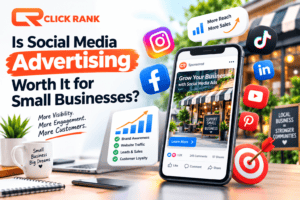
Is Social Media Advertising Worth It for Small Businesses?
As digital interactions increasingly shape how consumers discover and evaluate businesses, social media has become a valuable channel for maintaining brand visibility and audience relevance. In today’s digital economy, business visibility depends not only on what a company offers, but also on how effectively it connects with its audience.
Nowadays, everyone is on social media, scrolling through Reels, sharing posts, and taking pictures. But they are doing more than just consuming content; they are also discovering, interacting with, and engaging with brands.
For a small business owner, though, visibility comes at a price, and every dollar must earn its keep. Many have boosted a post, watched the likes trickle in, and wondered whether any of it turned into real customers. That uncertainty is the heart of the issue: limited budgets, crowded feeds, and results that are hard to trace.
ClickRank AI helps businesses focus on meaningful visibility and measurable outcomes. In this blog, you will learn what social media advertising costs, how it really performs, and how to decide whether it deserves a place in your marketing budget. Keep reading.
The Problem: Organic Reach Keeps Shrinking
Years ago, a well-timed post could reach most of your followers at no cost. Those days are long gone. Algorithms now reward content that earns instant engagement, and small accounts often get lost in the shuffle. Meanwhile, larger competitors buy their way to the top of the feed.
Relying on organic posts alone is like fishing in a pond that has quietly been drained. Once growth stalls, many owners turn to social media advertising services to put their message in front of people who have never heard of them.
What Does the Return Actually Look Like?
Every dollar you spend on ads should come back with company. Before launching a campaign, know what success looks like in real numbers, not vague promises. Here is how paid social can turn a modest, well-planned budget into measurable growth.
- Precise targeting: Reach people by location, age, interests, and online behavior instead of casting a wide net.
- Flexible budgets: Start small, learn what works, and scale only when the numbers justify it.
- Measurable results: Track impressions, clicks, leads, and sales in near real time.
- Retargeting: Re-engage visitors who browsed your site but left without buying.
Compare that with a billboard or a print ad, where you pay up front and hope for the best. With paid social, data replaces guesswork. A well-rounded package of social media marketing agency services typically bundles targeting, creative, and reporting under one roof.
When Social Media Advertising Pays Off
Social media advertising pays off when businesses have clear goals, a well-defined target audience, and relevant messaging. By combining strategic targeting, compelling creatives, and consistent performance tracking, businesses can turn advertising spend into meaningful engagement, qualified leads, and measurable growth. Ads pay off when these fundamentals are in place:
- You have a clear, compelling offer.
- Your product or service is visual or easy to explain.
- Your website or landing page is built to convert visitors.
- You can respond to leads quickly, ideally within hours.
When these pieces align, even a small budget punches above its weight. Businesses that lean on professional social media advertising services often reach this stage faster, because strategy, creative, and tracking are handled together. Working with an experienced provider such as ClickRank AI can help businesses bring these elements together and make more informed advertising decisions.
Technical Factors Behind Poor Ad Performance
Not every campaign is a success story. Money often goes down the drain for predictable reasons:
- No defined goal: “More exposure” is not a target, but “30 new bookings a month” is.
- Weak creative: Blurry photos and vague copy won’t stop a scroll.
- Missing tracking: Without conversion tracking, you are flying blind.
- Unrealistic expectations: Results rarely arrive overnight, and testing takes patience.
Even the best social media advertising services cannot rescue a campaign that has no clear destination. Throwing money at the wall to see what sticks a winning strategy is rarely.
DIY or Hire a Professional?
Many owners start on their own, and that is perfectly reasonable. Handling ads in-house keeps costs low and gives you full control, but it demands time most owners simply do not have. Platforms change constantly, and one small misstep in audience settings burns through a budget quickly.
This is where social media marketing agency services earn their keep. A seasoned team brings testing experience, creative talent, and benchmarks drawn from dozens of campaigns. If you decide to outsource, vet your options carefully:
- Ask for transparent pricing and clear monthly reports.
- Look for experience in your industry or a similar one.
- Avoid long lock-in contracts that limit your flexibility.
- Make sure results are tied to business goals, not vanity metrics like likes.
A reputable provider of social media marketing agency services will welcome these questions rather than dodge them.
How to Tell Whether It Is Worth It
Worth is measured in numbers, not impressions. Track these three:
- Cost per acquisition (CPA): What you spend to win one customer.
- Return on ad spend (ROAS): Revenue divided by ad spend. For example, $1,500 in ads that generate $6,000 in sales equals a 4:1 ROAS.
- Customer lifetime value (CLV): What a customer is worth over time, not just on the first purchase.
If your CPA sits comfortably below your CLV, the campaign is paying for itself. If not, adjust the offer, creative, or audience before increasing spend. Reviewing results monthly with your agency or your social media advertising services provider keeps small problems from snowballing.
Final Thoughts
So, is social media advertising worth it? For most small businesses with a clear offer and realistic expectations, the answer leans toward yes. It is not a magic wand, but it is a powerful lever when used wisely. The real question is how well it fits your goals.
- Where do you stand?
- Have you tried paid campaigns that fell short, or are you still on the fence?
- Would building skills in-house or partnering with experts suit your business better?
Start by setting one measurable goal and a small test budget, then let the data guide your next move. Share your experience, because every business learns from the stories of others.
Frequently Asked Questions
- Is social media advertising worth it for a small business?
Yes, when you have a clear offer, a defined audience, and tracking in place. Results depend on strategy and testing, so start small, measure everything, and scale only what works.
- How much should a small business spend on social media ads?
Start with a modest test budget you can afford to lose, then adjust. Many owners begin with a few hundred dollars monthly, increasing once cost per lead looks consistently healthy.
- How long does it take to see results from social media ads?
Early signals like clicks and leads often appear within days. However, most campaigns need two to four weeks of data before you can judge performance fairly and optimize with confidence.
- Which social media platform is best for small business ads?
It depends on where your customers spend time. Facebook and Instagram suit local and consumer brands, LinkedIn fits B2B, and TikTok works for visual, younger audiences. Test one or two.
- Is boosting a post the same as running an ad?
No. Boosting is a simplified shortcut with limited targeting and goals. Running ads through the platform’s ad manager gives you much more control over audiences, placements, objectives, and detailed tracking.
- Can I run social media ads myself, or should I hire someone?
You can start yourself if you have time to learn and test. Hire help when campaigns plateau, budgets grow, or managing ads starts pulling you away from running the business.
- What does a social media agency actually do for my business?
An agency plans strategy, builds audiences, designs ad creative, writes copy, sets up tracking, runs tests, and reports results, so you will be able to focus on serving customers instead of troubleshooting campaigns.
- How do I know if an agency is trustworthy?
Look for transparent pricing, real case studies, clear monthly reports, and flexible contracts. Be wary of guaranteed results, vague answers, or agencies that report likes instead of leads and sales.
- What is a good return on ad spend for a small business?
Many businesses aim for at least 3:1, meaning $3 in revenue per $1 spent. The right target depends on your gross profit margins, so calculate your true break-even point first.
- Why are my social media ads not working?
Common culprits include fuzzy goals, weak creative, poor targeting, slow landing pages, and missing tracking. Review each element carefully, change one variable at a time, and give tests enough time.
- Do social media ads work better than organic posting?
They serve different purposes. Organic posts build trust and community, while ads deliver speed and reach. Together they work best, because ads amplify content that already resonates with your audience.
- Can I target local customers only?
Yes. You can target by city, ZIP code, or a radius around your location. This keeps your budget focused on nearby customers who can realistically visit your shop or book.
- What should I include in a high-performing social media ad?
Use a strong visual, a benefit-focused headline, a clear offer, and one obvious call to action. Keep the message simple and make sure the landing page truly matches the promise.
- What metrics matter most for small business ads?
Focus on cost per lead, cost per acquisition, return on ad spend, and conversion rate. Impressions and likes look nice, but they rarely pay the bills all on their own.
- Do I need a website to run social media ads?
Not strictly, since you collect leads through forms, messages, or calls. Still, a fast, mobile-friendly website builds credibility, supports your ads, and usually converts more visitors into paying customers.
One Response