

How to Structure Content So AI Answer Engines Quote It?
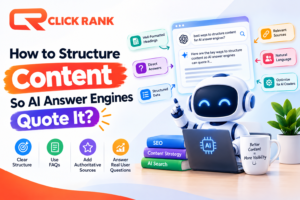
Search technology is moving toward AI-generated answers. Rather than offering a list of links, search engines now rely on artificial intelligence to deliver direct, comprehensive responses. This shift means that producing quality content alone is no longer sufficient. Nowadays, AI reads across multiple sources, picks the clearest answer, and quotes it directly, so content that is hard to extract gets skipped.
Today’s top priority is to build every page around a single, focused question, open with a one-sentence direct answer, and rely on clear, question-style headings. Keep paragraphs short, three to four sentences at most, and write in precise, structured language. Avoid long, intimidating blocks of text, and build self-contained chunks of content that make sense on their own. Add schema markup so machines know what each section contains.
For brands that want expert support, Answer Engine Optimization Services turn these choices into consistent citations across ChatGPT, Perplexity, and Google. In this guide, you will learn how to write direct answers, organize sections, and implement schema markup for AI engines. Keep reading.
What Does It Mean for Content to Be Quotable?
Quotable content is content that an AI system can extract, attribute, and present without editing. It states a complete idea in the opening sentence, names its subject, and requires no surrounding text. Think of each section as a standalone card rather than a chapter in a novel.
This matters because retrieval systems evaluate passages, not entire pages. Each passage competes independently for a citation. Strong structure gives every passage a fair chance.
Why Does the Bottom Line Up Front Principle Work?
The Bottom Line Up Front (BLUF) principle works because it places the core answer where machines look first. Lead with the answer, directly beneath the heading, before any history, preamble, or backstory. Readers benefit too, since they reach the payoff in seconds. Aim for a direct answer of 40 to 60 words. That range is long enough to be complete and short enough to be quoted cleanly.
How Should You Write Headings That Match Real Queries?
Phrase each heading as the precise question that users type or say aloud into a search engine. “How do I structure content for AI?” Outperforms a clever, poetic title because it states the section’s scope clearly. Keep every H2 and H3 to a single idea.
Then apply the “drop the fluff” rule. The first sentence after every heading should answer that heading using a clear subject-verb-object structure. Compare the two openings below.
- Weak: “There are many things to consider when thinking about headings.”
- Strong: “Question-based headings help AI engines match a section to a query.”
How Can You Make Every Section Stand on Its Own?
Make a section stand on its own by restating its subject, defining its terms, and finishing its thought within the same block. Avoid hidden dependencies, such as “as mentioned in step one” or “see the previous section.” If an AI pulls the passage out of context, it must still make complete sense.
Structure each page around one clear question, then divide the answer into self-contained chunks. Each chunk addresses a single sub-question. This approach lets a model cite one section without distorting the rest.
Which Formatting Choices Help Machines Extract Facts?
Bullets, numbered lists, and HTML tables help machines extract facts because each element carries one labeled unit of information. Use bullet lists for single facts, with each bullet holding exactly one idea, and numbered lists for ordered processes so the sequence is preserved.
Reserve HTML tables for pricing, specifications, and other numerical data, where labeled rows and columns make comparisons easy to parse. Write definitions as one-sentence paragraphs so each forms a clean, quotable unit, and pair every common question with a short answer beneath its heading to match the way people phrase queries.
How Long Should Paragraphs Be?
You don’t need to keep paragraphs long; instead, they should run three to four sentences at most. Avoid long blocks of text; use simple punctuation, mainly periods and commas. Limit em dashes and unusual symbols that disrupt parsing.
Precise, structured language also supports voice assistants such as Siri, Alexa, and Google Assistant, which read selected passages aloud. Remember, short sentences should be natural when spoken.
Why Do Named Entities and Schema Markup Matter?
Named entities matter because AI models link facts to identifiable things, not to vague references. An entity can be a brand, product, person, tool, or concept, such as Google Search Console, Schema.org, Microsoft Copilot, or ChatGPT. Replace phrases like “this tool” or “the platform” with the proper name every time.
Complement entity-rich writing with JSON-LD structured data:
- FAQ Page schema labels question-and-answer pairs.
- How To schema labels sequential instructions.
- Article schema labels authorship and publication dates.
- Organization schema labels brand identity.
How Do AEO and GEO Differ?
AEO targets the single selected answer, while GEO targets a citation inside a synthesized response. AEO stands for answer engine optimization, and GEO stands for generative engine optimization. Both rely on the same structural foundation, so the difference lies in what you measure.
- AEO success looks like a featured snippet, a voice answer, or a direct answer box.
- GEO success looks like a brand mention or citation inside ChatGPT, Perplexity, or Google AI Overviews.
How Do Answer Engine Optimization Services Improve Quotability?
Answer Engine Optimization Services improve quotability by auditing existing pages and rebuilding them around extractable answers. A specialist identifies buried answers, rewrites opening sentences, and adds schema. The work is usually faster than producing new content, which makes it a practical first investment.
Typical deliverables include the following:
- A content audit that flags hidden dependencies.
- Rewritten Direct Answer Blocks for priority pages.
- JSON-LD schema implementation.
- Entity mapping for brands, products, and authors.
Can Voice Search Optimization Services Strengthen Your Structure?
Yes, because spoken queries are conversational and often begin with who, what, when, where, why, or how. A structure built on questions suits them naturally. A specialist tests whether each opening sentence works when read aloud and whether it delivers the answer in a single, clear breath.
What Do AI Search Visibility Services Track?
These services track how often AI platforms mention, cite, and describe your brand accurately. Monitoring spans ChatGPT, Perplexity, Google AI Overviews, and Gemini. Core metrics include citation frequency, share of voice, referral traffic, and answer accuracy.
What Are the Most Common Structural Mistakes?
The most common mistakes are burying the answer, using vague headings, and writing paragraphs that depend on earlier context. Each mistake forces an AI to guess, and models tend to skip uncertain passages. Avoid these errors:
- Opening with a long story before answering the question.
- Using titles such as “The Real Power Behind AI Blogging” that signal no scope.
- Relying on pronouns like “it” or “this tool” without a named subject.
- Bundling several ideas into one dense paragraph.
- Hiding numerical data inside sentences instead of a table.
What Does a Before-and-After Example Look Like?
A before-and-after example shows a vague opener replaced by a direct, quotable answer. The improved version names its subject, states one fact, and needs no context.
- Before: “Many businesses wonder about visibility, and there are lots of factors involved.”
- After: “Perplexity cites pages that answer one clear question in the first sentence.”
Only the second sentence can be lifted into an AI-generated response without any supporting text.
What Should You Check Before Publishing?
Review each page against a short checklist before it goes live:
- The H1 closely matches the SEO page title.
- The heading is phrased as a real question.
- A direct answer of 40 to 60 words follows it.
- Every section works if quoted alone.
- Single facts appear in bullets, and data appears in tables.
- Entities are named, and schema validates without errors.
The Bottom Line
Content earns AI citations when each section answers one question, stands alone, and uses precise, entity-rich language. Combine disciplined structure with Voice Search Optimization Services and AI Search Visibility Services from ClickRank AI, and your pages become dependable sources that answer engines quote with confidence.
One Response