
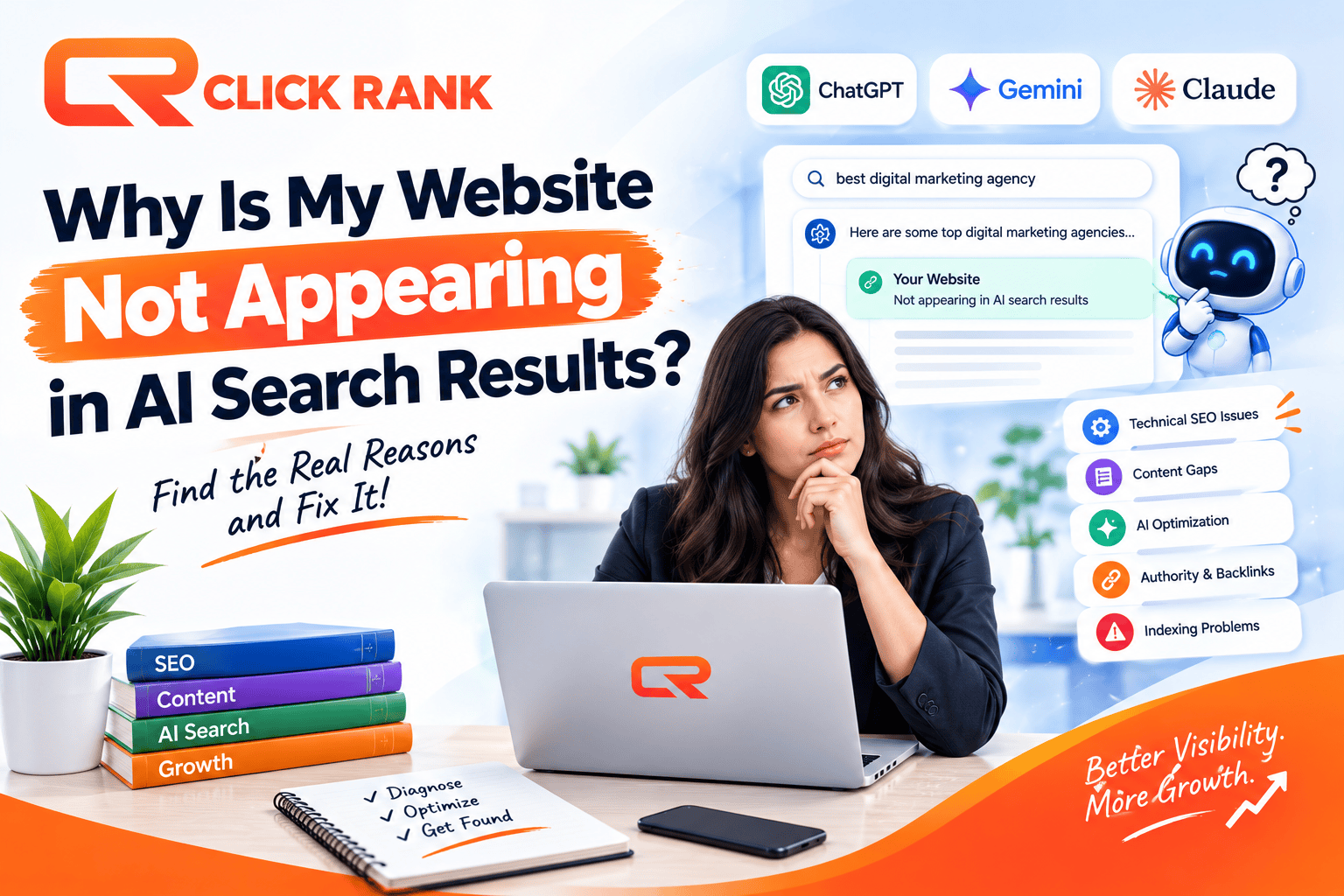
Your website appears on the first page of Google, but when someone asks an AI tool a question related to your business, your website is nowhere to be found. Frustrating, right? That’s because ranking on Google and appearing in AI-generated answers are two different things. AI tools look for information that helps answer a person’s question, and they may choose content from sources other than the websites that rank highest on Google.
If your website doesn’t provide clear answers, or search systems struggle to access its pages, your business might miss out on these opportunities. The answer isn’t to keep publishing more blogs and hope for the best. First, you need to understand what’s going wrong. This blog explains why your website might not appear in AI search results and what you can do to improve its chances. Let’s get started!
Check Whether AI Search Systems Can Access Your Website
Before changing your content, check whether AI search systems can actually access your website. Think of it this way: if a search system can’t read your pages, it may not be able to use your information in its answers.
A few technical settings might be getting in the way. For example, your website might accidentally tell search systems not to visit certain pages, prevent them from indexing your content, or return errors when they try to open a page.
Different AI platforms also use different methods to find information. OpenAI, for example, uses a crawler called OAI-SearchBot to help its search features discover website content. This is separate from GPTBot, which is used for purposes related to AI model training. Google has its own systems for discovering and indexing web pages, too.
Here are a few things to check:
- Review your robots.txt file: Make sure it isn’t accidentally blocking important pages from search crawlers.
- Check your page settings: Look for settings that tell search engines not to index pages you want people to find.
- Look for website errors: Make sure important pages load properly instead of showing error messages.
- Check how your pages appear: Confirm that the main content is visible when the page loads, rather than hidden behind technical issues.
- Review available reports: Use tools such as Google Search Console and your website’s server logs to spot crawling or indexing problems.
Fixing these issues makes it easier for search systems to access your content. However, it doesn’t guarantee that your website will appear in AI-generated answers. Your content still needs to be useful, relevant, and trustworthy.
Understand Why Google Rankings Do Not Guarantee AI Visibility
A page ranking well in traditional search may still be absent from an AI-generated response. That’s because ranking in a conventional search engine and being selected as a source for an AI answer are different outcomes.
Depending on the platform, an AI system may retrieve relevant documents, interpret the user’s question, and generate a response using selected sources. Your page must be relevant to the particular query and accessible through the platform’s retrieval process.
For example, a digital marketing agency might rank for a broad keyword such as “digital marketing services” but lack a detailed page explaining how AI SEO consulting addresses crawlability, entity recognition, or AI search visibility.
How to improve your approach:
- Create focused pages that address specific user questions.
- Match content to informational and commercial search intent.
- Support important claims with credible evidence.
- Build clear connections between related topics.
- Monitor AI mentions and citations separately from organic rankings.
The goal is not to abandon traditional SEO. It is to strengthen the strategy, so your content serves both conventional search journeys and relevant AI-driven discovery experiences.
Structure Content So AI Systems Can Interpret It Clearly
Even useful information can lose its impact when buried beneath vague headings, lengthy introductions, or disorganized explanations. Clear content structure helps readers navigate a page and can make its information easier for automated systems to interpret.
Consider a page targeting “AI SEO consulting.” Instead of relying on broad headings such as “Our Approach,” organize the information around specific questions:
- What is AI SEO consulting?
- Why is a website missing from AI search results?
- How can businesses improve AI search visibility?
- How does answer engine optimization differ from traditional SEO?
Answer each question directly before expanding with technical details, examples, and supporting evidence.
Use descriptive H2 and H3 headings, meaningful internal links, concise paragraphs, and relevant lists. Add structured data when it accurately describes the page and follows the applicable schema guidelines.
Remember, structured data is not a shortcut to AI citations. Its value lies in providing machine-readable context where supported, while useful content remains essential.
Strengthen Topical Authority and Brand Entity Clarity
If your website covers dozens of loosely connected topics without demonstrating meaningful expertise in your core services, search systems and potential customers may struggle to understand what your business does best.
Build a focused content ecosystem around your expertise. For an agency offering AI SEO consulting, this might include technical SEO audits, AI search visibility, answer engine optimization, content retrieval, and measurement strategies.
Link related articles to relevant service pages so users can move naturally from learning about a problem to exploring a solution.
Maintain consistent business information across your website and legitimate third-party profiles. Where appropriate, earn relevant mentions through expert commentary, original research, useful industry contributions, and digital PR.
The objective is not to manufacture brand mentions. It is to establish a credible, consistent digital presence that accurately communicates your expertise.
Use Answer Engine Optimization to Address Specific Questions
Answer engine optimization services help businesses organize content around the questions people ask through conversational search and AI-powered tools. Rather than optimizing every page around a single keyword, identify the underlying questions, concerns, and decisions that matter to your audience.
For instance, a business owner exploring AI SEO consulting may also want to know how AI visibility is measured, whether traditional SEO still matters, and how to identify technical barriers. Answer engine optimization services help address these needs by developing useful content with clear explanations, relevant examples, and verifiable information. Include FAQs where they genuinely help readers rather than simply adding keyword variations. Avoid promising guaranteed AI rankings or citations, as no legitimate optimization method guarantees that every AI platform will mention your website.
Measure AI Search Visibility and Identify Content Gaps
You cannot fix what you never investigate. Track whether your website appears in relevant AI-generated answers, which pages receive referrals from AI platforms, and how your visibility changes over time.
Use available analytics, server logs, search performance reports, and repeatable query testing to build a clearer picture.
Compare your website with competing sources that appear for relevant questions. Look for differences in answer quality, topical coverage, technical accessibility, and supporting evidence.
Because AI responses can vary by query, location, platform, and time, treat individual observations cautiously. Focus on recurring patterns rather than isolated results. A structured audit can help you prioritize meaningful improvements instead of making random changes.
When Should You Consider AI SEO Consulting?
If your website remains absent from relevant AI answers despite having useful content, it may be time to review your strategy more systematically.
Professional AI SEO consulting can help identify technical barriers, content gaps, weak topical coverage, and measurement problems. The right approach connects these findings to specific actions rather than recommending disconnected optimizations.
When evaluating a provider or searching for the best digital marketing company for your needs, look for transparent auditing methods, realistic expectations, clear reporting, and recommendations grounded in evidence.
Ask how the team distinguishes crawling problems from content-selection issues and how it measures progress beyond traditional keyword rankings.
At ClickRank AI, we help you with a strong consulting strategy should help you understand why visibility is limited, what needs to change, and how to evaluate whether those changes are working.
Conclusion
Missing from AI search results does not automatically mean your website has poor SEO. The cause could be technical accessibility, unclear content, insufficient topical depth, or the way a particular platform retrieves information.
Start with a technical audit, strengthen your content structure, demonstrate genuine expertise, and measure visibility across relevant search experiences. Combine these steps with traditional SEO rather than treating AI optimization as a replacement.
When choosing the best digital marketing company for your business, look for a team that understands technical SEO, AI search visibility, and content strategy while setting realistic expectations. With a focused strategy and consistent evaluation, your business can build a stronger foundation for discovery in an increasingly AI-driven search environment.