
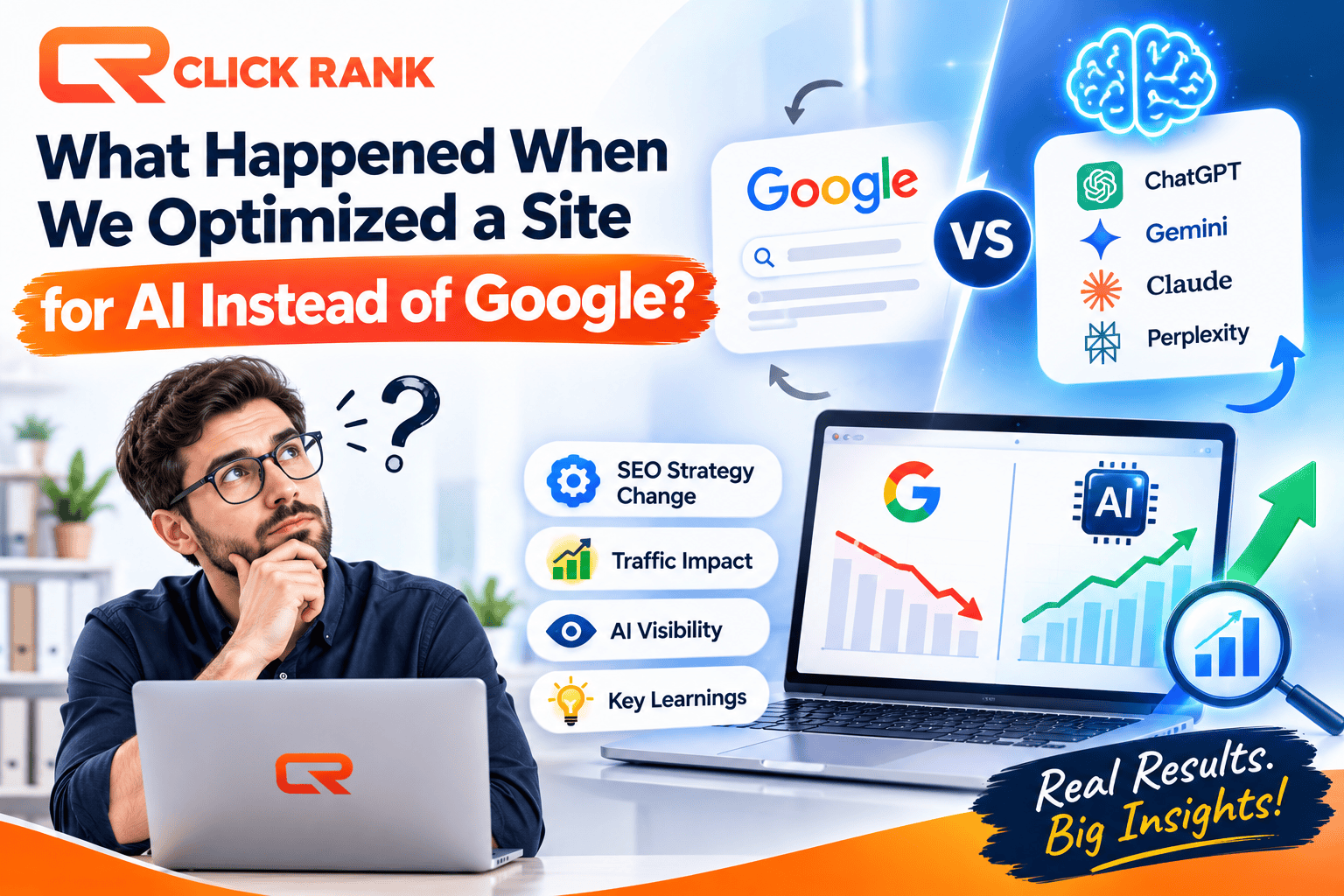
Search is quietly changing. Google still matters, but a growing number of people now get answers from AI tools that never send them to a website at all. That creates a real problem: you can rank well and still go unseen. We wanted to know what would happen if we stopped writing for search engines and started writing for AI.
We rewrote our content, restructured our pages, and tracked what followed. Some outcomes were predictable, and others were not. In this blog, you will read what we tried, how AI and Google responded differently, and which lessons are worth applying to your own site. Keep reading.
Why We Ran This Experiment
For years, the goal was simple: rank on page one of Google. But AI tools like ChatGPT, Gemini, and Perplexity work differently. They do not show a list of options. They read information from across the web and give one summarized answer.
Here is an easy way to picture it. Google is like a library catalog. It points you to the right shelf, and you do the reading. An AI assistant is like a librarian who has already read the books and tells you the answer. If the librarian never read your book, you never get mentioned.
This creates a real problem. A site can rank on page one of Google and still never appear in an AI answer. That gap is why many businesses now turn to an AI SEO agency to understand how these tools choose their sources.
Our goal was simple. We wanted to find out whether a website could earn AI mentions without chasing traditional rankings. For businesses looking to understand this changing search landscape, ClickRank AI highlights the importance of building visibility across both traditional search engines and AI-powered platforms.
The Starting Point: Meet the Test Site
- Monthly organic traffic: Number of visits.
- AI mentions: Zero or close to zero.
- Branded search volume: Number of searches per month.
To measure AI visibility, we wrote a fixed list of 40 real customer questions. Every week, we asked those same questions in ChatGPT and other AI tools. Then we recorded whether the brand was mentioned, cited, or ignored. Using the same questions every time kept the test fair. It showed us real trends instead of random ups and downs.
The Five Changes That Made the Difference
- We answered questions directly: Every page now opened with a clear, one- or two-sentence answer before diving into detail. AI tools prefer content they can lift cleanly, much like a student who quotes the sentence that says it best.
- We structured content for machines and humans: We added clear headings, short paragraphs, and FAQ sections. A well-organized page is easier for a language model to read and easier for a person to skim.
- We built entity clarity: An “entity” is simply a clearly defined thing, such as a brand, a person, or a service. We made sure the company name, services, location, and expertise were described the same way across the site and across the web. Consistency helps AI tools understand who you are.
- We added original data and real experience: AI models tend to favor sources that offer something new. We added case studies, firsthand insights, and original statistics instead of repeating what every other site says.
- We strengthened trust signals: We added author bios, cited reliable sources, and earned mentions on credible third-party sites. These signals tell both people and machines that the information is reliable.
Think of it as writing for a very smart but very literal reader who skims everything. The clearer your page is, the easier it is for that reader to quote you. This approach is the heart of LLM optimization services, which focus on making content understandable and quotable to large language models. This is also where ClickRank AI fits into the broader conversation about AI-focused optimization, helping businesses recognize the value of clear content, consistent brand information, and stronger AI search visibility.
The Results Were Not What We Expected
The first noticeable change appeared after about [six to eight] weeks. Here is what we saw by the end of the test:
- AI mentions: They grew from starting number to ending number across our 40 test questions.
- Referral traffic from AI tools: It rose by X percent, starting from a small base.
- Lead quality: Visitors from AI tools were more informed when they arrived, and they converted at a higher rate than average search visitors.
Not everything improved, and we want to be honest about that. Our traditional Google rankings stayed flat, and a few pages dipped slightly. Overall traffic did not jump the way a typical SEO campaign might promise.
The biggest surprise was the quality of the traffic. Fewer clicks did not mean fewer customers. By the time people clicked through, the AI had already answered their basic questions, so they came ready to talk to us.
Four Lessons Worth Taking Home
After the test, four lessons stood out:
- AI optimization and Google SEO overlap, but they are not the same job: Good content helps both, but AI tools care more about clear answers and trusted sources than keyword placement.
- Clarity beats cleverness: Simple, direct writing wins every time.
- Trust is built off-site as much as on-site: Mentions on other credible websites matter.
- Measurement is still messy: AI answers change from day to day, so track trends instead of single data points.
This is why more brands are now investing in ChatGPT SEO services alongside their regular search strategy. They are not replacing Google. They are widening their reach.
Is This Right for Your Business?
AI optimization tends to help most when customers research before they buy. That includes:
- Service businesses and local providers.
- Software and SaaS companies.
- Publishers and educators.
- Ecommerce brands with research-heavy buyers.
It is not a magic switch, and results take time. But if your customers ask questions before they spend money, AI visibility deserves a place on your radar. Platforms and resources such as ClickRank AI can help businesses explore this shift and understand why preparing their websites for AI-driven discovery is becoming increasingly important.
So, What Works Best for You?
AI search is not replacing Google overnight, but it is clearly changing how people find answers. The smartest approach is not to pick one over the other. It is to build a foundation that serves both.
Here is a simple way to decide where to start:
- If your Google rankings are strong, begin by restructuring your top pages so they answer questions directly.
- If you are starting from scratch, build clear, authoritative content first, then layer in AI-focused improvements.
- If you lack the time or resources, consider working with an AI SEO agency to run a small, focused pilot.
ClickRank AI creates value for businesses looking to strengthen their digital presence. By focusing on AI search visibility, content clarity, and evolving optimization practices, we help brands work toward becoming easier for AI platforms to understand, recognize, and recommend. The result is an opportunity to expand brand discovery, reach audiences through emerging search experiences, and build a stronger foundation for long-term online visibility.