
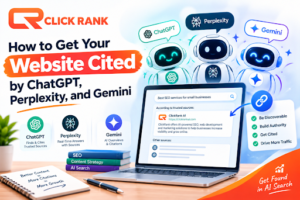
A few years ago, SEO had a straightforward goal: get your website onto Google’s first page and win the click. But the digital landscape has changed. Today, people are turning to AI tools like ChatGPT, Gemini, and Perplexity to research products, compare services, and discover businesses without digging through pages of search results. That shift opens a new door for businesses: getting their websites mentioned or cited in AI-generated answers. Here’s the catch: ranking well on Google does not automatically earn a
spot in AI responses. These platforms need relevant, reliable, and easy-to-understand information to deliver useful answers. Here comes the question: How can a website get noticed by AI? With the right AI SEO services, businesses can focus on creating content worth citing, building strong Experience, Expertise, Authoritativeness, and Trustworthiness (E-E-A-T) signals, and making website pages accessible to AI crawlers. In this guide, you’ll discover practical ways to help your website become a credible source that AI platforms can find, understand, and cite.
Why AI Citations Matter and How They Work
Getting cited by AI search engines means having your website referenced in AI-generated answers. Instead of simply appearing in search results, your pages may be linked when ChatGPT, Perplexity, or Gemini answers questions, compares products, or recommends services. For example, someone searching for an ecommerce SEO provider may receive an AI-generated list of recommendations with links to relevant websites. The goal is to make your website easy for your audience to find, understand, and trust. Although no strategy guarantees citations, strong content, technical accessibility, and brand credibility can improve your chances. An experienced AI SEO Agency can help businesses strengthen these areas.
How Can You Create Content Worth Citing?
Content worth citing provides clear answers, useful evidence, and information readers can verify. To support their responses, AI systems need relevant sources; broad, generic articles and claims without proof contribute little. What you need to do is start by pinpointing the questions your audience genuinely asks.
Cover topics such as pricing, comparisons, common problems, and practical solutions. Use question-led headings, short paragraphs, bullet points, and comparison tables. Answer each question immediately, then explain the details. For example, instead of claiming that SEO improves visibility, explain how keyword research, technical optimization, and relevant content help attract qualified visitors. Include original research, case studies, expert insights, and credible references where appropriate. Think of your content as a helpful conversation, not a keyword dump. Clear, useful answers give readers and AI systems a stronger reason to reference your website.
How Can You Build Strong E-E-A-T Signals?
E-E-A-T stands for Experience, Expertise, Authoritativeness, and Trustworthiness. These principles show why people should find your content trustworthy and authentic. Publish accurate author biographies, relevant credentials, and practical insights from real projects.
Support important claims with reliable sources and documented results. Make your business information easy to verify. Include clear service descriptions, contact details, customer testimonials, and genuine case studies. For example, an SEO agency like ClickRank AI will help you explain how it resolved technical issues, improved product pages, and measured organic traffic changes. E-E-A-T is not a direct AI citation formula. However, demonstrating expertise and trustworthiness helps establish the credibility your content needs.
Technical Steps to Make Your Website AI-Crawler Friendly
AI crawlers are automated programs that discover and process website content. If important pages are inaccessible, AI-powered search experiences may struggle to retrieve them. Start by checking your robots.txt file. Ensure relevant crawlers, including GPTBot, OAI-SearchBot, PerplexityBot, and Google-Extended, are not unintentionally blocked. These bots serve different purposes, so review their individual access requirements. Next, ensure important content appears in accessible HTML. Avoid relying entirely on JavaScript to display essential answers. Improve page speed, fix broken links, maintain logical internal linking, and submit an accurate XML sitemap. These technical improvements are important components of effective AI SEO Services. Remember, allowing crawlers to access your website does not guarantee indexing or citations. It simply removes a potential technical barrier.
What Is Structured Data and Why Does AI Need It?
Structured data describes webpage information in a standardized format. It helps search engines interpret relationships between your business, services, products, and content. Use relevant Schema.org markup in JSON-LD format. Depending on your website, consider:
● Organization to identify your business.
● Service to describe your offerings.
● Product to explain product details.
● Article to identify published content.
● Breadcrumb list to clarify page navigation.
Ensure your markup accurately reflects visible content. Validate it using Google’s Rich Results Test or the Schema Markup Validator. Structured data improves machine-readable context, but it does not guarantee AI citations or higher rankings.
How Can You Optimize Content for ChatGPT, Perplexity, and Gemini?
Each platform uses different retrieval mechanisms. Focus on sound SEO fundamentals while considering how each system discovers information.
● ChatGPT: Maintain authoritative content and allow relevant OpenAI search crawlers to access pages you want considered for search citations.
● Perplexity: Publish clear, evidence-based answers supported by reliable references. Its search-oriented responses commonly link to supporting sources.
● Gemini: Maintain strong Google Search fundamentals, accurate business information, and credible author details. You need to use headings like “How much does ecommerce SEO cost” Remember to follow each heading with a direct answer. Keep facts, definitions, and comparisons easy to extract. Avoid burying useful information beneath lengthy introductions or unnecessary jargon.
Why Do Brand Mentions and Consistency Matter?
To understand businesses and check their claims, AI systems may rely on more than one source. Your website counts, but your wider digital footprint gives extra context. Keep your company name, services, location, and description consistent across your website, LinkedIn company page, Google Business Profile, and relevant directories. Build credibility through digital PR, industry publications, expert contributions, customer reviews, and relevant community discussions. For online stores, well-planned E-commerce SEO packages can support product page optimization, technical improvements, and content development as part of a broader strategy to strengthen search visibility. Avoid artificial mentions and spammy backlinks. Focus on earning genuine recognition by sharing useful insights and delivering reliable services.
How Can an AI SEO Agency Improve Your AI Visibility?
An experienced AI SEO Agency can help improve technical accessibility, structure content for AI retrieval, strengthen authority signals, and monitor brand citations. When evaluating AI SEO Services, look for providers that explain their methods, establish measurable goals,
and report meaningful progress. Avoid anyone promising guaranteed AI citations. For online retailers, suitable E-commerce SEO packages should also address product-page optimization, category content, structured data, crawl efficiency, and conversion performance.
The Bottom Line
Getting cited by ChatGPT, Perplexity, and Gemini requires more than adding AI-related keywords. Create content worth referencing, make your website accessible, demonstrate genuine expertise, and maintain consistent brand information. Build trust, answer real questions, and keep improving. That is how ClickRank AI helps position your website for greater visibility in an evolving AI search landscape.